
Having a Baby at 40: The Identity Crisis No One Warns You About
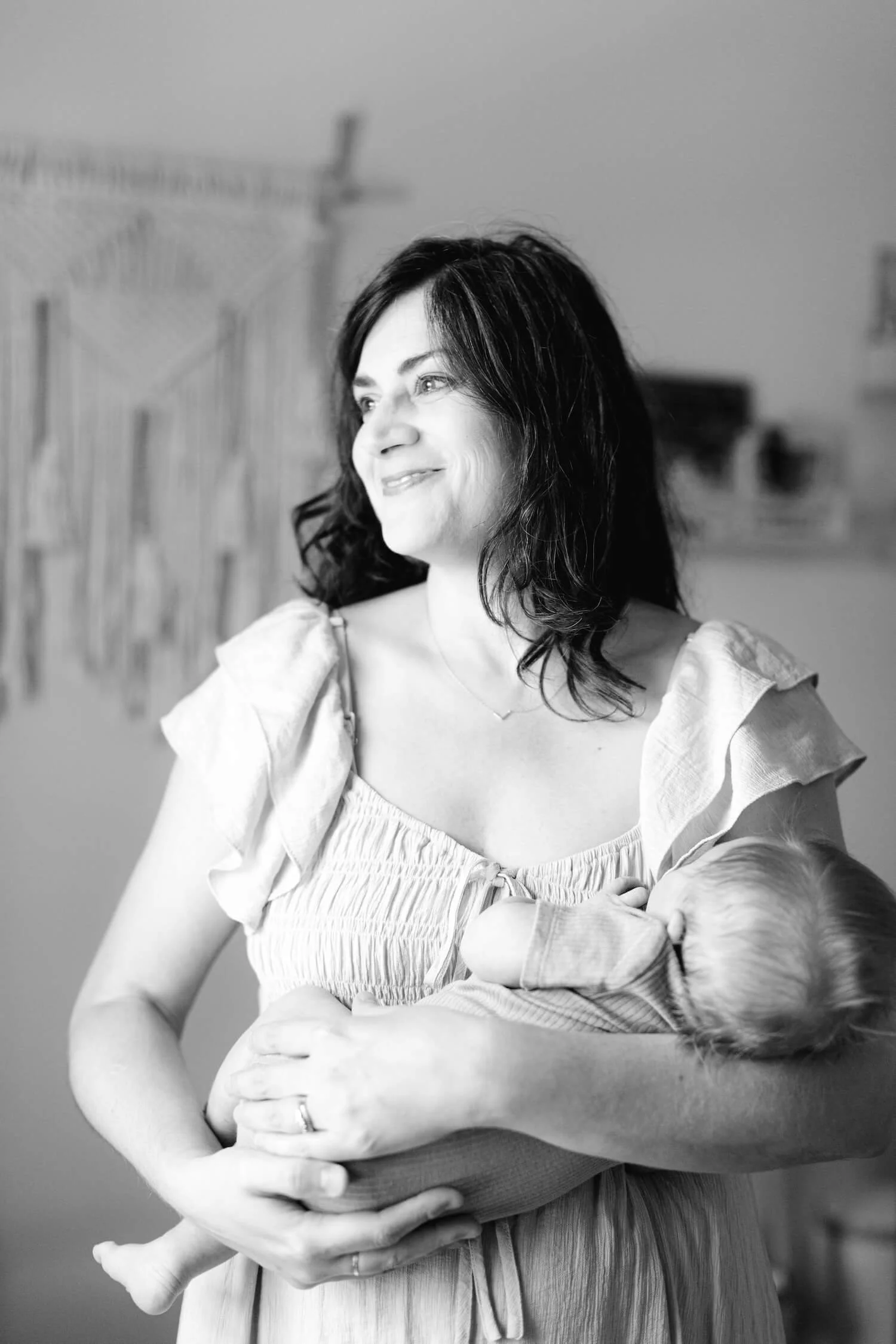
Photo by Nicki Metcalf Photography
Table of Contents
I had my baby at 40. Nine days before my 40th birthday, actually. After four years of infertility and one round of IVF that finally worked.
I thought I'd be more equipped to handle motherhood because I was older. I'd been a physical therapist for 13 years, a coach for 5 years. I'd traveled to 43 countries. I knew who I was. I had my life figured out.
And in many ways, I was right. I was more equipped. I had emotional maturity, self-knowledge, and patience I wouldn't have had at 25.
But the identity crisis was also more intense. Because I had more to lose.
Having a baby at 40 doesn't just add a new role to your life. It reshapes everything you've built. And when you've spent 40 years becoming someone, when you finally know who you are and what you need, that reshaping is both harder and more intentional than it would have been earlier.
This is what no one tells you about having a baby in your 40s. Not the medical system, not the parenting books, not the other mothers. They tell you about the risks. They don't tell you about the identity shift. They don't tell you that being more established makes the loss more painful but also gives you tools to rebuild stronger.
Having a Baby at 40: What Makes It Different From Having a Baby at 25
When you have a baby at 40, you're not just adding motherhood to your life. You're integrating it into an already established identity.
At 25, you might not know who you are yet. You're still figuring out your values, your needs, your rhythms. Motherhood becomes part of that discovery process. The identity shift is still profound, but you're building from a less established foundation.
At 40, you know yourself. You've spent decades learning what you need. You've created routines that support your nervous system. You've built a life that works for you. You've figured out how to be yourself in the world.
And then a baby arrives, and all of that has to be reorganized.
Here's what changes when you become a mother at 40:
Autonomy shifts dramatically. You've spent 40 years making your own decisions about how to spend your time, where to go, what to do. Suddenly, every decision is filtered through someone else's needs. You can't leave the house without planning around naps and feeds. You can't make plans without considering childcare. Your time is no longer entirely your own.
Alone time becomes scarce. At 40, you likely know that you need solitude to recharge. You've built that into your life. Motherhood removes it temporarily. There's very little alone time. Very little quiet. Very little space to think or process or just be.
Your established routines dissolve. The morning coffee ritual. The evening walk. The weekend reading time. Whatever rhythms you've built to support yourself—they have to be rebuilt around a baby's needs.
Your identity touchpoints shift. The work you do. The hobbies you pursue. The friendships you maintain. The parts of yourself that aren't about being a mother. They don't disappear entirely, but they become less accessible temporarily.
Your body changes in ways that feel more jarring. At 40, you know your body. You know how it moves, what it needs, how it recovers. Pregnancy and birth change it in ways that feel more noticeable because you had more familiarity with who you were before.
This is what makes motherhood at 40 different. You know what you're losing temporarily. You had it. And now you have to rebuild it differently.
But here's what you gain that younger mothers don't have: You know yourself well enough to recognize when you're reaching your limit. You have the emotional maturity to regulate yourself and therefore your child more effectively. You have the wisdom to know what actually matters and what doesn't. You have the capacity to build stronger boundaries. These tools are your superpower, even when the loss feels overwhelming.
Before I became a mother, I knew myself. I'd done the work. I'd traveled alone to 43 countries. I was adventurous. I loved novelty and newness. I had a solid friend group. I knew I loved reading, art, poetry. I needed a lot of alone time and low sensory environments to feel whole.
I'd been a doctor of physical therapy for 13 years. I'd been a certified coach for 5 years. I was well into my second career. I'd just discovered I was neurodivergent a few years before getting pregnant, and I was learning how to work with my nervous system instead of overriding it.
At 40, I felt more established in who I was than I ever had. I thought that would make motherhood easier. And in some ways it did. I was more patient. I could regulate my emotions better. I knew what mattered.
But in other ways, it made the transition harder. Because I had more to lose.
When my son arrived, everything I'd built had to be reorganized. And because I'd had more to lose, the grief was more acute. But because I was older, I also had more tools to navigate it.
Motherhood Identity Crisis: Why an Established Self Makes the Shift More Complex
The motherhood identity crisis at 40 is different because you actually had a self to reorganize.
You weren't still figuring out who you were. You knew. You'd built a life around that knowledge. You'd created structures that supported your needs. You knew what mattered to you.
And then motherhood asks you to rebuild all of that around a new reality.
I couldn't travel anymore. I couldn't have quiet time. I couldn't pursue photography or poetry or art in the ways I used to. I couldn't spend time with friends as easily. I couldn't even be alone for five minutes. My entire life became more insular than I'd ever experienced.
My son was very high-needs. He cried 8 to 10 hours a day for months. He had colic, silent reflux, and needed every single contact nap on my body for over a year. It took two hours to get him down for each nap, and sometimes he'd only sleep for 30 minutes before we had to start all over again.
But even mothers with more typical babies experience this identity shift. Even if your baby sleeps well, even if they're content and easy, you still lose autonomy temporarily. You still lose alone time. You still lose the ability to make decisions about your own life without considering someone else's needs first.
What makes it more complex at 40 is that you know what you're missing. At 25, you might not have fully appreciated your freedom yet. At 40, you do. You know exactly what you're losing temporarily. And you grieve it more acutely.
There was no novelty in my days anymore. No adventure. No quiet time. No alone time. Every day was groundhog day. There was no way to get my own needs met amidst the relentless demand of my son's needs.
I didn't recognize myself. In so many ways. My body. My capacity. My sense of self. All of it was unrecognizable.
For at least a year, I was completely unrecognizable to myself. I knew what I was missing. I knew what had been taken from me temporarily. I grieved my freedom, my autonomy, my ability to have quiet time or do as I pleased. I felt very constrained, like my life wasn't my own anymore. That was jarring.
I also grieved my body. It didn't feel the same. It didn't look the same. It didn't function the same. I felt like I'd lost ownership of my own body in ways that went beyond the physical changes of pregnancy and birth.
This is the part of having a baby at 40 that no one talks about. Everyone focuses on the medical risks. No one mentions the identity shifts. No one prepares you for the fact that an established sense of self makes the reorganization more painful but also more intentional.
And yet. Because I was 40, I also had tools I wouldn't have had at 25. I knew when I was approaching my limit. I could name my needs, even if I couldn't always meet them immediately. I had emotional maturity that helped me regulate my son's big feelings. The identity shift was more painful, but the rebuilding was also more intentional. I knew what I was rebuilding toward.
If you're also navigatinglosing yourself in motherhood alongside other life transitions, the compounding identity shifts can feel overwhelming.
Perimenopause and Pregnancy: The Overlap No One Tells You About
Here's something else no one prepares you for when you're having a baby in your 40s: perimenopause and pregnancy can happen at the same time. And then perimenopause and postpartum can overlap. And you won't be able to tell which symptoms are coming from which hormonal shift.
Perimenopause typically starts in your mid-40s, but it can begin earlier. If you're having a baby at 40, 41, 42, 43, there's a real possibility that you're already in early perimenopause when you get pregnant.
And even if you're not in perimenopause during pregnancy, postpartum can trigger it. The hormonal crash after giving birth can push you into perimenopause earlier than you would have entered it otherwise.
Here's why this matters: the symptoms overlap completely.
Hot flashes. Are they postpartum night sweats? Or perimenopause hot flashes? You can't tell.
Mood swings and depression. Is it postpartum depression? Or perimenopause-related depression? Or both compounding each other?
Exhaustion. Is it because you have a newborn? Or because perimenopause makes you more fatigued? Or because you're 40 and your body recovers more slowly? All of the above, probably.
Weight that won't budge. Is it postpartum weight? Or perimenopause changing your metabolism? You don't know.
Brain fog. Postpartum or perimenopause? Both cause it.
Low libido. Postpartum hormones or perimenopause? Impossible to separate.
I was likely already in very early perimenopause when I was in early postpartum. But it hit full force once I stopped breastfeeding. Hot flashes. Lower libido. Depression that felt different from postpartum depression but also indistinguishable from it.
Was I depressed because of postpartum hormones? Or perimenopause hormones? Or the infertility depression that I'd carried through pregnancy and never fully processed? I couldn't separate them. It was all just one overwhelming hormonal storm.
I started bioidentical hormone replacement therapy, which helped with the physical symptoms. The hot flashes eased. But the depression stayed. And I couldn't tell if that was postpartum, perimenopause, or both compounding each other.
What I know now is that perimenopause absolutely compounded my postpartum depression and anxiety. The hormonal crash after giving birth combined with perimenopause created something much more severe than either one alone would have caused.
And no one warned me. Not my OB. Not my midwife. Not any of the postpartum resources I read. They all talked about postpartum depression. None of them mentioned that if you're over 40, you might also be dealing with perimenopause at the same time.
Pregnancy During Perimenopause: When You Can't Tell Which Hormones Are Which
Pregnancy during perimenopause is disorienting in ways that are hard to describe.
Your body is already changing from perimenopause. Then pregnancy changes it more. Then postpartum changes it again. And you're trying to figure out what's normal aging, what's pregnancy, what's postpartum, and what's perimenopause.
I noticed I had way more trouble losing weight postpartum than I ever had in my life. Was that because I was 40? Because of pregnancy? Because of perimenopause slowing my metabolism? I didn't know.
I looked in the mirror and felt like I'd aged two to three years overnight. My face looked different. My body looked different. Was that postpartum? Was that perimenopause? Was that just what happens when you have a baby at 40?
The exhaustion was crushing. But was that because I had a newborn? Or because I was 40? Or because perimenopause makes you more fatigued? All of the above, probably. But when you can't separate the causes, you can't address them individually.
And the medical system doesn't help. Doctors either blame everything on postpartum (give it time, it'll get better) or blame everything on your age (well, you're 40, what do you expect). No one connects the dots. No one says, "You might be experiencing both perimenopause and postpartum at the same time, and that compounds everything."
I had to figure it out myself. And even now, years later, I'm not sure I fully understand which symptoms came from which hormonal shift.
What I do know is this: if you're having a baby after 40, assume perimenopause is part of the equation. Don't let doctors dismiss your symptoms as "just postpartum" or "just your age." Insist on being seen as a whole person navigating multiple overlapping hormonal transitions at once.
If you're navigatingperimenopause alongside motherhood, you're dealing with two major hormonal and identity transitions simultaneously.
Signs You're Experiencing Perimenopause and Postpartum Simultaneously
If you're postpartum and over 40, here's how to recognize if perimenopause might be overlapping:
Hot flashes that don't match typical postpartum night sweats. Postpartum night sweats usually happen in the first few weeks and then taper off. If you're still having hot flashes months postpartum, especially after you've stopped breastfeeding, that's likely perimenopause.
Depression that feels different from typical postpartum depression. Postpartum depression often improves with time, sleep, and support. If your depression feels deeper, more chemical, more resistant to the things that usually help, perimenopause might be compounding it.
Weight that won't budge no matter what you do. Postpartum weight typically responds to reasonable diet and movement. If you're doing everything "right" and your weight isn't shifting, perimenopause might be changing your metabolism.
Libido that doesn't return. Postpartum libido often stays low while breastfeeding and then gradually returns. If it doesn't return after you stop breastfeeding, perimenopause is likely a factor.
Brain fog that persists beyond the newborn phase. Postpartum brain fog improves as sleep improves. If you're sleeping reasonably and still can't think clearly, perimenopause might be contributing.
Periods that return irregularly or don't return at all. If your period comes back but is irregular, heavier, lighter, or unpredictable, that's a perimenopause sign.
If you're experiencing several of these, talk to your doctor about perimenopause. Ask about hormone testing. Consider bioidentical hormone replacement therapy if it's appropriate for you.
And know that you're not imagining it. You're not weak. You're not failing. You're navigating two massive hormonal transitions at the same time, and that's legitimately harder than either one alone.
Having a Baby in Your 40s vs. Your 20s: What You Gain and What You Lose
People ask if it would've been easier to have a baby younger. The answer is complicated.
What you gain by waiting until 40:
Emotional maturity. You're better able to regulate yourself, and therefore your child. You have more patience. You don't sweat the small stuff as much. You know what actually matters. This is a genuine superpower in parenting.
Self-knowledge. You know your triggers. You know your needs. You know when you're approaching your limit. That self-awareness makes you a better parent because you can take care of yourself before you're completely depleted.
Wisdom to pass down. You've lived more. You've learned more. You have more life experience to offer your child in terms of perspective, values, and how to navigate challenges.
Financial stability. (Usually.) You're more likely to be established in your career. You're more likely to be able to afford help, childcare, and support that makes the transition easier.
Stronger boundaries. You're less likely to sacrifice yourself completely. You're more likely to advocate for your needs. Eventually. It might take time, but you have the tools to build boundaries that protect your wellbeing.
Less concern with what others think. At 40, you care less about fitting into the "good mother" mold. You're more comfortable doing things your way, even if it's different from what everyone else does.
What you lose by waiting:
Energy. You have less physical stamina at 40 than you did at 25. Recovery is slower. Sleep deprivation hits harder. Your body doesn't bounce back as quickly.
Time with your child. If you have a baby at 25, you'll likely be around longer. You'll be younger when they're adults. You'll have more years with them.
Fertility journey complexity. The journey to get pregnant is often harder. Infertility is more common. IVF may be necessary. The emotional and physical toll of trying to conceive is real.
Compressed timeline. If you want more than one child, the window is narrower. The pressure is higher. The timeline feels urgent in ways it wouldn't have at 25.
But here's the truth: I don't think I could have done this much earlier. I don't think I was ready. It was the right time for me, even though it was physically harder. Even though the identity shift was more intense. Even though perimenopause complicated everything.
At 40, I had less ability to override my body's signals. In my 20s, I might have been able to push through exhaustion, ignore my needs, sacrifice myself more easily. At 40, my body wouldn't let me. That was both harder and healthier. It forced me to learn boundaries faster.
I also had stronger emotional regulation. I could stay calm when my son was dysregulated in ways I'm not sure I could have managed at 25. I could hold space for his big feelings because I'd learned to hold space for my own.
It took about three years postpartum, but I finally learned to advocate for myself in ways I don't think I would have been capable of at 25. I reached a point where I knew I had to establish more equitable care in our home or I'd be completely swallowed up. And I did it. I stepped up through absolute hell and fire, but I did it. And I had the tools to do it because I was 40.
So yes, having a baby in your 40s is different. You have less energy. Your body recovers more slowly. Perimenopause complicates everything. The identity shift is more intense because you have more to reorganize.
But you also have more emotional capacity. More self-knowledge. More ability to become the parent your child actually needs instead of the parent you think you're supposed to be. More wisdom. More patience. More boundaries.
Your age is your superpower, even when it doesn't feel like it.
If you're navigatingmidlife alongside new motherhood, the intersection of these two major identity shifts can feel overwhelming.
Mom Over 40: The Social Landscape (And Finding Your People)
One thing many women don't anticipate about being a mom over 40 is how different the social landscape can be.
Most of the moms in playgroups are 10 to 15 years younger. You're at different life stages. They're building careers while you're well into your second one. They have different priorities, different concerns, different experiences. You don't share the same cultural references.
The age gap matters less than you'd think it would, but it still creates a subtle distance. You might not relate to the same shows, the same music, the same formative experiences. Conversations can feel slightly out of sync.
And when moms get together, the conversation often centers entirely on children and mothering. At 40, you want to talk about life outside of motherhood. You want to be full humans together, not just mothers comparing notes on your children. But that can be hard to find.
For me, there was another layer. My son was so high-needs that I couldn't relate to other mothers' experiences. They'd talk about nap schedules and sleep training and I'd think, "My son doesn't nap unless he's on my body. It takes two hours to get him down. He screams 8 to 10 hours a day. Your experience is not my experience."
But even without a high-needs baby, the social landscape shifts. You're navigating different challenges than younger mothers might be facing.
Here's the upside though, and this is important: At 40, I'm less concerned with fitting in. I'm more comfortable being myself, even if that means not matching the typical mom narrative. I know what I need, and I'm learning to ask for it. I'm less likely to sacrifice my boundaries to be included in groups that don't actually nourish me.
That clarity is something younger me didn't have. I would have contorted myself to fit. At 40, I don't. And that's a gift, even when it means feeling like I don't quite fit anywhere for a while.
The loneliness is real. But so is the freedom to be yourself without apology.
Pregnancy After 40: Beyond "Geriatric Pregnancy" and Medical Risk
Let me be very clear about something: the term "geriatric pregnancy" is a load of shit.
I never subscribed to that label. I found providers who agreed with me. Providers who didn't make me do things just because of my age, but who looked at how I was actually doing. My labs. My body. My pregnancy as a whole.
I switched providers from people who wanted to label me as high-risk based solely on my age to a midwife who was incredibly supportive and treated me like a whole person, not a risk category.
And here's what made me angry: no one ever mentioned the identity shift. Not once. Every medical appointment focused on risk. Advanced maternal age. Higher chance of complications. More monitoring. More tests.
Not a single provider asked, "How are you doing with the identity transition of becoming a mother at 40?" No one acknowledged that this might be different emotionally, psychologically, socially than becoming a mother at 25.
The medical system is so focused on physical risk that it completely misses the psychological and identity shifts that come with pregnancy after 40. And those shifts are real. They deserve attention. They deserve support.
If you're pregnant or postpartum after 40, find providers who see you as a whole person. Who don't reduce you to your age or your risk category. Who understand that your experience includes but is not limited to medical concerns.
And know that the identity work is real. It's not secondary to the medical stuff. It's just as important. Maybe more important.
Postpartum at 40: The Depth of Depression and Anxiety (And Getting Help)
I need to be very honest about something. The postpartum depression and anxiety I experienced was severe. Debilitatingly severe.
I prayed I wouldn't wake up. Not in an actively suicidal way, but in a "please just let me disappear" way. I wanted to not exist. The weight of everything was so crushing that I couldn't imagine continuing.
Postpartum depression at 40 can be more severe for several reasons:
Hormonal complexity. If perimenopause is overlapping, you're dealing with two hormonal crashes at once. The postpartum crash plus the perimenopause hormonal shifts create a perfect storm.
Higher expectations. You're older. You thought you'd be better equipped. You're more established. You feel like you should be able to handle this. When you can't, the shame is worse.
More to reorganize. You had a life that worked. You had autonomy. You had routines. You had an identity. Losing all of that temporarily creates grief that compounds the depression.
Physical exhaustion. Your body recovers more slowly at 40. Sleep deprivation hits harder. You don't have the same physical reserves you would have had at 25.
Neurodivergence. If you're neurodivergent (whether you know it or not), you're at much higher risk for severe postpartum depression and anxiety. The sensory overload of a newborn is overwhelming for neurodivergent nervous systems.
For me, the depression was compounded by multiple factors. The infertility depression I'd carried through pregnancy. The postpartum hormonal crash. Perimenopause hitting at the same time. Being neurodivergent and completely overwhelmed by sensory input. Having a high-needs baby who never stopped crying.
It was an overwhelming hormonal storm. I couldn't separate what was causing what. Was this postpartum depression? Perimenopause? Infertility grief? Neurodivergent burnout? Yes. All of it. Everything at once.
What I learned later is that neurodivergent people are at much higher risk for severe postpartum depression and anxiety. No one told me that. If they had, I might have gotten help sooner. I might have been on medication from the start. I might have had more support in place.
If you're postpartum at 40, please know this: severe depression is not a personal failure. It's a biological reality for some of us, especially if you're neurodivergent, especially if perimenopause is overlapping, especially if you had depression during infertility or pregnancy.
Get help. Get on medication if you need it. Hire people. Ask for more support than you think you should need. Your child is healthiest when you are healthy. This is not negotiable.
What Actually Helps When You're Navigating Motherhood at 40
Here's what actually helps when you're having a baby at 40 and your established identity is shifting:
Get more support than you think you need. Way more. Don't wait until you're drowning. Hire help. Ask family. Get a postpartum doula. Get a night nurse if you can afford it. You need more support at 40 because your body recovers more slowly and because you're navigating more complex hormonal shifts.
Know your limits and don't gaslight yourself out of them. At 40, you know what you need. You know when you're approaching your limit. Don't override those signals. Don't tell yourself you should be able to handle more. Listen to your body. This is your superpower—use it.
Advocate for yourself early. Don't wait three years like I did. Start establishing equitable care from the beginning. Ask for what you need. Set boundaries. You have the tools to do this because you're 40. Use them.
Get on medication if you need it. If you're struggling with depression or anxiety, don't wait. Get evaluated. Get on medication if it's appropriate. There's no shame in needing chemical support through a massive hormonal transition.
Find providers who see you as a whole person. Not just your age. Not just your risk category. Find an OB or midwife who acknowledges the identity work alongside the medical work.
Grieve what you've lost temporarily. You don't have to pretend you're fine. You don't have to be grateful all the time. You can grieve your freedom, your autonomy, your alone time, your established routines. Grief and love can coexist.
Remember your strengths. You're more emotionally mature. You're more patient. You know yourself better. You have wisdom younger mothers don't have yet. These are real advantages, even when the adjustment feels overwhelming.
Give yourself three years. Not three months. Three years. That's how long it took me to feel like myself again. Not the same self I was before. A different self. But a self I recognized and could inhabit. And honestly, a stronger self.
Know that both things are true. It's harder in some ways and better in others. You're a better parent because you're older. And you're struggling more because you have more to reorganize. Both can be true.
The Three-Year Transformation: Rebuilding Identity After 40
It took about three years postpartum for me to feel like myself again. Not the same self I was before. A different self. But a self I recognized and could inhabit. And honestly, a stronger self.
The transformation happened because I reached a breaking point. I knew I had to establish more equitable care in our home or I would be completely swallowed up. I couldn't keep losing myself. I couldn't keep sacrificing everything. I had to learn to advocate for my needs or I wouldn't survive.
So I did. I learned to set boundaries. I learned to ask for help. I learned to say what I needed instead of waiting for someone to notice. I stepped up in ways that were only possible because I'd been through absolute hell and fire. And because I was 40, I had the emotional tools to do it.
And now, at three years postpartum, I feel stable enough to consider having a second baby. Not before. It took three years to get here.
This is what I want you to know if you're in the thick of it right now: it doesn't stay this hard forever. You do come out the other side. It just takes longer than anyone tells you. Especially if you're neurodivergent. Especially if you had a high-needs baby. Especially if you're dealing with perimenopause at the same time.
Give yourself three years. Not three months. Three years. That's how long it took me to find my footing. To rebuild. To become someone I recognized again.
There's no going back to who you were before. That version of yourself is gone. But you can find who you are now. And that process can be exciting and meaningful, even though it's also painful and disorienting. Because you're 40, you have the self-knowledge to rebuild intentionally. That's your advantage.
Second Baby at 43: What I Know Now That I Didn't Know Then
I'm trying for a second baby now, at 43. The decision feels completely different than it did the first time.
This time, I'm more grounded in my desire. I'm less swayed by what other people think I should do. I'm not doing this because I feel like I'm supposed to have two kids. I'm doing it because I want to. And that clarity makes everything different.
I'm also both scared and excited. Scared because I know what's coming. The identity shift. The exhaustion. The risk of depression. The sensory overwhelm. I'm scared of drowning again.
But I'm also more prepared. I know what kind of support I need. I know to expect breastfeeding to be hard. I know I'll be overwhelmed by the amount of medical appointments. I know how to advocate for myself now. I have providers lined up that I trust. I know what's normal for an infant and what's not.
The identity transition won't catch me off guard this time. I know there's no going back to who I was. I know I'll have to grieve and rebuild again. But I also know that finding who I am on the other side can be exciting. It's not just loss. It's also emergence. And I have the tools to navigate it because I'm 43.
Getting to this point wasn't easy. Between my first baby and trying for a second, I went through a massive health crisis. I was carried out of my house on a stretcher, taken to the hospital in an ambulance because I was in such severe pain. I had imaging done that found a mass on my bone. They thought it was cancer. I thought I had cancer for over a month.
It turned out to be benign, but I had to do very intensive physical therapy to get my pain levels down and become functional again. I've fought tooth and nail to get my body to a place where it's ready for another baby. Not to mention getting my son to a place where another child would even be possible.
So this second pregnancy, if it happens, will feel different. More bittersweet. More precious. I know it's our last. I know I'll never do this again. I'm 43. I've been through hell to get here. And I want to relish it in a way I couldn't the first time. Because I'm older, I can appreciate it more deeply. That's the gift of age.
What I Wish Someone Had Told Me About Having a Baby at 40
If I could go back and tell my 40-year-old pregnant self anything, here's what I'd say:
You're going to need more support than you think. Way more. Hire people. Get help. Don't wait until you're drowning. You have the wisdom to know this—trust it.
High-needs babies exist. Not all babies are "typical." If you get one, it's not your fault. It's not because you're doing something wrong. It's just who your baby is. And you're going to need even more support because of it.
Perimenopause and postpartum can overlap. Pay attention to that. Don't let doctors dismiss your symptoms as "just postpartum" or "just your age." Insist on being treated as a whole person navigating multiple transitions at once. You're old enough to advocate for yourself—do it.
If you're neurodivergent, you're at much higher risk for severe postpartum depression and anxiety. Get on medication. Get help early. Don't wait. You know yourself well enough to know when something is off—trust that.
Know your needs. Don't gaslight yourself out of them. It's okay to ask for the support and help you need. Do whatever you need to do to be healthy, because your child is healthiest when you are healthy. This is not selfishness—this is wisdom.
There's no going back to who you were. But you can find who you are now, and that's exciting and meaningful. It's okay to grieve. And it's okay to do things differently than society tells you to. This is your motherhood and your kid's childhood. You get to do it your way. You're old enough to know that now.
Give yourself three years. Not three months. Three years. That's how long it takes to rebuild. And you will rebuild stronger because you have the tools.
Your age is your superpower. Even when it doesn't feel like it.
For Women Having a Baby in Their 40s: What You Need to Know
Having a baby at 40 or beyond is not just about medical risk. It's about identity shifts. And those shifts are real and valid and deserve to be acknowledged.
You will reorganize parts of yourself temporarily. If you're more established at 40 than you were at 25, that reorganization will be more complex. You'll know what you're losing. You'll grieve it more acutely.
But you'll also bring more emotional maturity. More self-knowledge. More capacity to regulate yourself and therefore your child. You'll be a better parent in many ways because you're older. You have tools younger mothers don't have yet.
The key is knowing that both things are true. It's harder in some ways. It's better in others. And you deserve support that acknowledges the complexity instead of reducing you to a risk category or an age bracket.
Get the support you need. Find providers who see you as a whole person. Hire help. Get on medication if you need it. Don't wait until you're drowning to ask for more. You're old enough to know what you need—honor that.
And know that if it takes three years to feel like yourself again, that's normal. If you're neurodivergent, if you had a high-needs baby, if perimenopause is overlapping, it might take even longer. That doesn't mean something is wrong with you. It means you're navigating multiple massive transitions at once.
You can do this. It's hard. It's harder than anyone tells you. But you can do it. You have emotional maturity, self-knowledge, wisdom, patience, and the ability to set boundaries that younger mothers are still learning. These are your superpowers.
And there are people (like me) who understand what you're going through and can help you stay connected to yourself through the dissolution and the rebuilding.
Your age is your advantage, even when it feels like a liability.
Ready for Support?
"Through working with Kim I've been able to find inner security. I've learned to manage my feelings by talking with my body. This work has been absolutely life-changing." — A.S.
If you're ready to work with your body instead of around it, here's how we can work together:
Threshold Clarity Session ($150) — Not sure how to navigate motherhood at 40+ when your established identity is dissolving? A focused asynchronous day on Voxer where we map what's ending, what you need to stay whole through this transition, and how to advocate for the support that actually helps. 100% money-back guarantee if you don't have clarity. 100% credited toward Crossing the Threshold if you book within 7 days—making this essentially a $0 trial.
Crossing the Threshold ($500/month) — Private somatic coaching for women navigating motherhood at 40+, perimenopause and postpartum overlap, or neurodivergent parenthood. After 3 months: advocate for yourself without guilt, know your limits and boundaries, hold your needs alongside your child's needs, and rebuild identity that honors both who you were and who you're becoming. 2 sessions/month, Signal support, personalized practices. 3-month minimum.
Join My Newsletter — Get bi-monthly letters on identity transitions, thresholds, and the journey from self-abandonment to sovereignty. Reflection questions, somatic practices, and honest insights from my own threshold crossings—matrescence, midlife, faith deconstruction, and the ongoing work of sovereignty.
